About Me
I’m glad you found your way here and are interested in my artistic work and in me as a person.
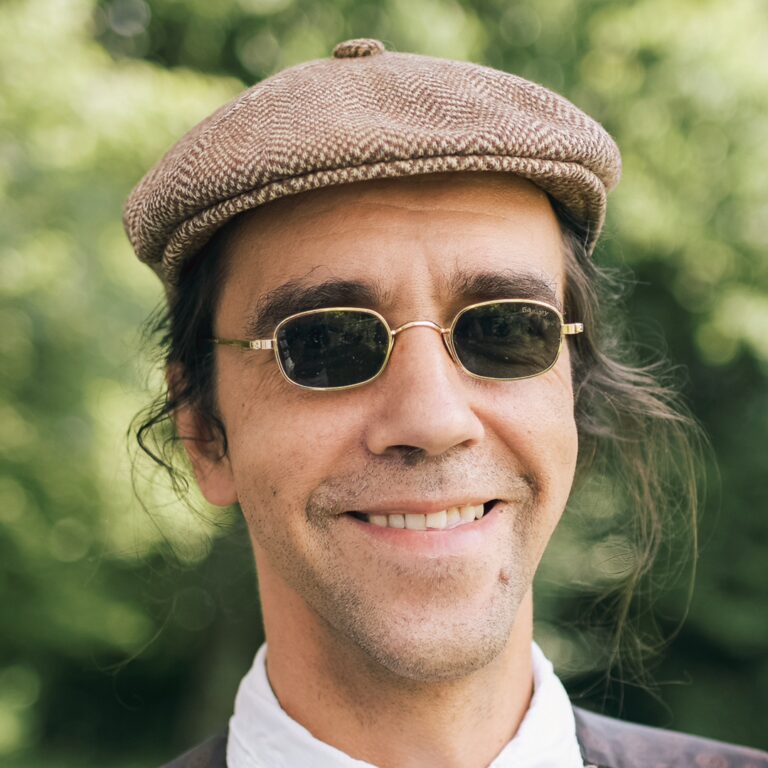
My name is Florian Tschörner, and I work as a visual artist in my studio in Klagenfurt am Wörthersee.
Here, I try things out, experiment, discard ideas, and start over. Much of my work begins with a small observation and only develops into a finished piece as I work on it. Some ideas stay with me for a long time and evolve into extensive series.
This gives rise to a wide variety of visual worlds in watercolor, ink, and acrylic, which I’d love to share with you.

Art begins with perception
If you just look a little more closely, the world suddenly becomes even more interesting. A bird pauses for a moment in the branches to preen its feathers. Beneath the shrub, the reflections of light on a puddle shift, creating ever-changing sparkles. A cloud passing in front of the sun shifts the color tones, and suddenly the landscape seems to expand, with nearby objects appearing to recede into the distance.
I’m interested in these moments—the things that are easily overlooked, and the moments that trigger something within us when we pay attention to them. That’s why my paintings repeatedly explore perception and the possibilities that open up when we view the world from a different perspective.
How we perceive our surroundings, light and color, humor and joy shapes our view of the world and our own lives.
Art Grows from Diversity
Born in Innsbruck and raised in a family with a strong artistic background, I began learning the violin and viola at an early age. Music shaped my understanding of rhythm, composition, and expression long before I became deeply involved in the visual arts.
After finishing school, my path first led me into the world of film and television. My engagement with visual language, perspective, light, and visual dramaturgy became an important foundation for my later artistic work.
This was followed by several years in software development with a focus on multimedia. For me, the connection to my current artistic work lies in the structure and design of visual communication and in the challenge of transforming an idea into something visible and impactful.
In my hometown of Innsbruck, I founded and curated the off-space gallery “verbale forum,” ran “the early bird,” a venue for live music, and, together with authors and journalists, published the regional cultural magazine “verbale magazin.”
These projects have repeatedly shown me just how much can emerge when different people come together with their ideas and use them to shape art and culture. That’s why, for me, art goes far beyond mere creation. It facilitates encounters, raises questions, shifts perspectives, and develops positions that have an impact beyond one’s own studio.
Art matures through exchange
My training as an artist did not, therefore, follow the traditional path through an art academy, but has been shaped to this day by observation and experimentation, by trial and error—and above all, by a great deal of disciplined and focused work in the studio. At the same time, however, artistic development is never a solitary endeavor for me.
Interaction with other artists has had a significant influence on my path. Encounters and conversations with Heinz Greissing, Ilse Abka-Prandstätter, Egone Scoz, and most recently Thomas Riess and Sissa Micheli have provided me with particular inspiration. Hopefully, my artistic development will never be complete.
It is probably precisely this non-linear path that characterizes my work: the freedom to constantly seek new paths for my own journey, and the openness to learn from everything and from many people.
Art Is About Contemplation
At first glance, my works could hardly be more different.
There are contemplative landscapes, detailed watercolors, lively illustrations, and humorous drawings.
What unites them all is my way of looking at the world. Nothing and no one is exactly like anything or anyone else. Diversity is not a contradiction to artistic identity; it is its very expression.
Landscape as a Space of Perception
My series “MEER SEHEN | mehr seen” is about vastness, the horizon, and a conscious gaze into the distance. My landscape images are less a depiction of a specific place and much more spaces for one’s own perception and thoughts. Sky, water, light, and color become the elements of open visual worlds in which the gaze can find peace and the mind is free to wander.
Captured in a single stroke
My ink drawings from the series “Mit spitzer Feder” are minimalist, incisive, and a little cheeky. Using just a few lines, I try to capture situational humor and human quirks with pinpoint accuracy. My drawings make people smile, but they also give them food for thought.
Celebrating Life with Color
My illustrative work stems from my joy in careful observation and my fascination with the diversity of nature. In my watercolors—of birds, fish, and baby animals, for example—I am not concerned with creating the most realistic depiction possible. Rather, I am interested in character and expression, and in the possibility of capturing personality in a single image.
Art culminates in its impact
Through my work, I hope to evoke something in the viewer. Perhaps just a second glance, a budding thought, a smile, or even the desire to look a little longer.
For me, a connection to nature and a zest for life are just as much a part of art as curiosity and humor. I like images that tell a story without laying everything out for you. I like works of art that leave room for your own thoughts while still taking a clear stance. In my work, I don’t want to explain the world, but rather to inspire a desire to look more closely.
About Florian Tschörner
Who is Florian Tschörner?
Florian Tschörner is an Austrian artist and the founder of “atelier vogelfrei.” He works in a variety of media, combining detailed observations of nature with painting, watercolor, illustration, and humorous ink drawings. His work explores perception, nature, the joy of life, and the question of how a different perspective can change the way we see the world.
Did Florian Tschörner study art?
No. Florian Tschörner’s path to art did not involve traditional training at an art academy. He has taught himself much through continuous work, observation, and experimentation. His interactions with other artists and his engagement with diverse artistic perspectives have also been formative for him. He therefore views his artistic development less as a completed education and more as an ongoing process.
How did Florian Tschörner get into art?
Florian Tschörner’s path to art was not a straightforward one. Raised in a family with a strong artistic background, he learned to play the violin and viola at an early age. Later, his education in film and television and several years in software development with a focus on multimedia repeatedly led him back to visual design. At the same time, his own artistic work continued to evolve—initially out of personal interest, and eventually as an independent career path.
Why does Florian Tschörner work with such a wide variety of styles and techniques?
Florian Tschörner’s works arise from a variety of observations and questions. A landscape may call for an open, contemplative visual language, while a humorous everyday situation might be best captured with just a few lines. When depicting an animal, he is interested in the combination of careful observation, character, and expression.
The diversity of his work is therefore not a conscious attempt to follow or avoid a particular style. It is an expression of his artistic curiosity and his freedom to seek the appropriate approach for each artistic idea.
What connects Florian Tschörner's various works of art?
What connects Florian Tschörner’s various works is his way of looking at the world. He is interested in the things that are easily overlooked: the unique atmosphere of a landscape, a bird in a brief moment of stillness, an unexpected everyday situation, or a detail that brings a smile to one’s face.
What inspires Florian Tschörner to create his paintings?
Nature plays an important role in Florian Tschörner’s work: landscapes, animals, the play of light, and small changes that are easily overlooked in everyday life. But “human nature” (quirks, everyday situations, conversations, etc.) and sometimes even a seemingly trivial thought can also serve as the starting point for a piece.
Why is “looking closely” so important to Florian Tschörner?
Florian Tschörner places such importance on looking closely because our perception influences how we experience the world.
In everyday life, we often notice things only in passing. A closer look, however, can reveal things that previously seemed insignificant: a particular play of light, a movement, an expression, or an unexpected beauty.
For Florian Tschörner, this experience is a fundamental starting point for his art. With his paintings, he does not seek to explain what the world is like, but rather to inspire viewers to take a closer look at it.